Low-Prep Drawing Activities for Kindergarten to 3rd Grade Students That They Actually Love
Simple, step-by-step drawing worksheets that build confidence, keep kids engaged, and require almost no prep time
3/27/20264 min read


This post contains affiliate links. If you click through and make a purchase, I may receive a small commission at no extra cost to you. I only recommend tools that I truly believe add value to the classroom or home learning environment.
I think we have all been there. You have ten minutes before the next transition, or maybe it is a rainy Tuesday afternoon, and the energy in the room is just starting to vibrate at a frequency that suggests impending chaos. You want to give them something to do that isn't "busy work," but you also do not have the mental bandwidth to set up a full scale art project with glitter and tempera paint. And, sometimes the idea of cleaning up one more tray of watercolor paint makes me want to hide in the supply closet.
That is where the "I can’t draw" problem usually starts. Have you noticed that around Kindergarten or First Grade, kids start getting really self critical? One day they are scribble-drawing masterpieces without a care in the world, and the next, they are staring at a blank piece of paper with this look of pure defeat because their cat looks like a lopsided loaf of bread. It is a tough phase. They have these big visions, but their fine motor skills are still catching up to their imaginations.
Maybe that is why step-by-step drawing works so well. I used to think it was a bit too "cookie-cutter," if I am being totally honest. I worried it might stifle their individual creativity. But then I watched a kid who usually gives up after two minutes spend nearly half an hour meticulously following a guide to draw a simple owl. He wasn't just copying. He was learning how to see. He was realizing that every complex thing in the world is really just a collection of circles, triangles, and lines. That is the secret sauce for the K through 3 crowd. When you break a scary task into tiny, manageable bites, the anxiety disappears.
I recently came across this massive toolkit called Drawly, and it is kind of a game-changer for this specific struggle. It is essentially a giant vault of over 500 drawing guides. The beauty of it is in the simplicity. There are no complicated instructions to read, which is great because, as we know, a room full of six-year-olds has about six different reading levels at any given time. It is all visual.
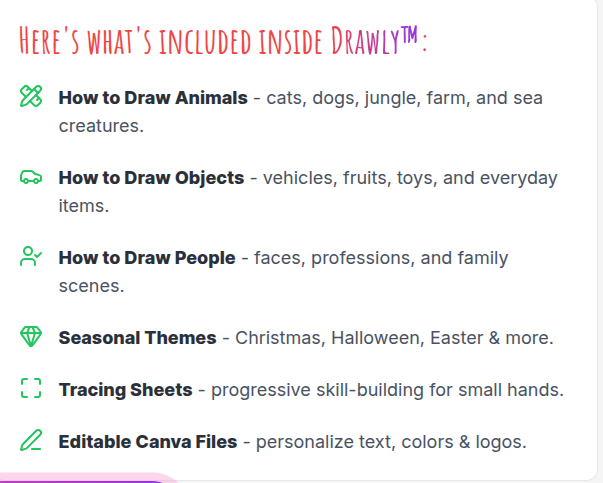
The variety is actually a bit overwhelming, in a good way. Animals, weather, food, seasonal stuff: it is all in there. I think the reason kids actually stay engaged with these is that they get a "win" almost immediately. Within five minutes, they have a recognizable drawing. That little boost of dopamine is usually enough to make them want to try another one, and then another. Before you know it, you have twenty minutes of focused, quiet concentration. Is there anything more beautiful than a quiet classroom? Probably not.
Actually, let’s talk about the "low prep" part for a second. We say "low prep" a lot in the education world, but sometimes that still means twenty minutes of cutting or laminating. For these, prep literally means hitting "print." You can print out a few different options and let them choose, which gives them that sense of agency they crave. Or, you can keep a binder of them for the "fast finishers" who always seem to be done with their work before you even finish giving the instructions.
There is also something to be said for how these activities help with handwriting. It sounds a bit like a stretch, but it really isn't. Drawing a steady curved line for a turtle’s shell uses the same muscles and coordination as writing a capital "C" or an "O." When they think they are just drawing, they are actually doing a workout for their hands. It is like hiding spinach in a smoothie.
I do wonder sometimes if we overcomplicate what kids need to be successful. We look for the most high-tech, flashy apps or the most expensive kits, but usually, a stack of paper and a clear guide is enough. There is a meditative quality to it. Even for me, watching the lines come together is oddly satisfying.
If you are looking for a way to fill those gaps in your day without adding more stress to your plate, you might want to check out Drawly. It is a solid investment if you want a library of resources you can pull from all year long, whether for a sub plan, a morning warm-up, or just a "we need a break" moment. You can find the whole bundle here if you want to see the specific designs.
At the end of the day, the goal is just to get them to feel like artists. Whether they follow the steps perfectly or end up giving their lion three tails and a top hat, the confidence they get from starting and finishing a drawing is what actually sticks. And if it gives you a few minutes to breathe or catch up on grading while they are happily occupied, well, that is just a very welcome bonus.


Connect
Join our newsletter for teaching tips
Contact
Subscribe
Ade@dovelearning.online
© 2025. All rights reserved.