Earth Day Math and ELA Activities for 4th and 5th Grade That Actually Keep Students Engaged
An easy, no-prep way to bring meaningful Earth Day learning into your classroom without overcomplicating your plans
3/26/20264 min read
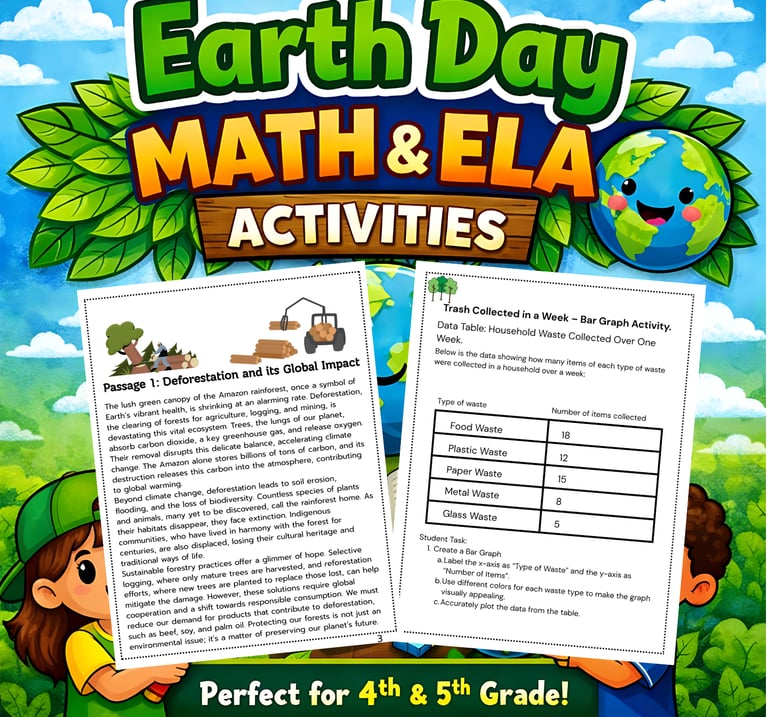
April always seems to sneak up on us. One minute you are dealing with the tail end of winter testing and the next, you realize Earth Day is right around the corner. To be honest, I think we’ve all been there where we realize on April 21st that we don’t have a solid plan. We want to do something meaningful, but who has the energy to reinvent the wheel when you are already juggling a million other things?
I’ve been thinking a lot about how we teach environmentalism to older elementary kids. By the time they get to 4th or 5th grade, they’ve already heard "reduce, reuse, recycle" about a thousand times. They get it. But they are also at an age where they start asking the harder questions. Why is the ocean full of plastic? What actually happens to the trees? I think they are ready for a bit more meat on the bone, which is exactly why I put together this Earth Day bundle.
Literacy That Actually Matters
The first half of this bundle is heavily focused on ELA, but not in a dry, textbook sort of way. I wanted to focus on three big topics: deforestation in the Amazon, the crisis of ocean plastics, and the rise of renewable energy. These are the things kids see on the news or hear about on YouTube, so bringing them into the classroom feels relevant.
Each passage is written specifically for that 4th and 5th-grade sweet spot. It is challenging enough to keep them on their toes, but not so dense that they tune out. Maybe the best part, at least for me, is the vocabulary support. We know how it goes. You give a kid a text about the "Great Pacific Garbage Patch", and they get stuck on words like "microplastics" or "biodiversity."
The bundle includes dedicated word banks with clear definitions. There are also these synonym and antonym organizers. I included those because I really believe that if a student can find a different way to say a word, they actually own it. It isn't just about memorizing a definition for a Friday quiz. It is about understanding the concept.
Bringing Math into the Green Conversation
I used to be one of those teachers who kept subjects in their own little boxes. Math was math, and science was science. But to be honest, Earth Day is the perfect time to break those walls down. Data is such a huge part of how we understand our planet.
In the math portion of this pack, students move away from reading and start doing. They work on bar graphs. I think there is something really satisfying for a 10-year-old to see raw numbers turn into a visual representation. They have to deal with scaling, labeling, and then actually interpreting what they’ve drawn.
There are word problems that require them to compare data points. How many more trees were planted this year versus last year? What is the trend? It makes the math feel a bit more "real world" than just solving for X on a worksheet. Maybe it's just a small shift, but I’ve noticed that kids engage more when the numbers represent something they care about, like animals or clean water.
The Power of a Good Fast-Finisher Activity
We all have those students. You know the ones. They finish a 20-minute assignment in about six minutes and then look at you with those "now what?" eyes. That is where the interactive puzzles come in.
I included a 15-word search and a crossword puzzle. I know, some people think puzzles are just filler, but I disagree. They are great for reinforcing the vocabulary they just read in the passages. If they have to hunt for the word "geothermal" in a grid, that spelling is going to stick. Plus, it gives the kids a bit of a mental break.
And then there are the coloring pages. To be honest, I think even 5th graders still love to color. It is therapeutic. The pages in this bundle are detailed enough that they don’t feel "babyish." They can be used as a cover for an Earth Day folder or just a quiet activity while you are finishing up small groups. Sometimes we forget that kids need that creative outlet, too.
Making Teacher Life a Little Easier
Let’s talk about the practical side for a second. This is a "no-prep" bundle. You print it. That’s it. In a perfect world, we would all have hours to hand-craft every single lesson, but we don't live in that world. We live in a world of faculty meetings and piles of grading.
I made sure to include the necessary answer keys. The math problems, even the word search. There is nothing worse than trying to find one last hidden word in a word search while a student is hovering over your shoulder. Everything is laid out clearly so you can grade quickly and get back to your actual teaching.
Maybe you use this as a full week of Earth Day curriculum. Or maybe you just pull out the math sheet for a quick Friday lesson. It’s flexible. At the end of the day, my goal was just to create something that makes the kids think and makes the teacher’s life a little less chaotic.
Earth Day is a great reminder that we are all stewards of this place. I think if we can get our students excited about the science and the data behind it, we are doing a good job. It doesn't have to be perfect. It just has to be engaging. Click here to get yours now.
Connect
Join our newsletter for teaching tips
Contact
Subscribe
Ade@dovelearning.online
© 2025. All rights reserved.